

Data Center Power Distribution Unit Market to Expands through USD 2.34 billion by 2034
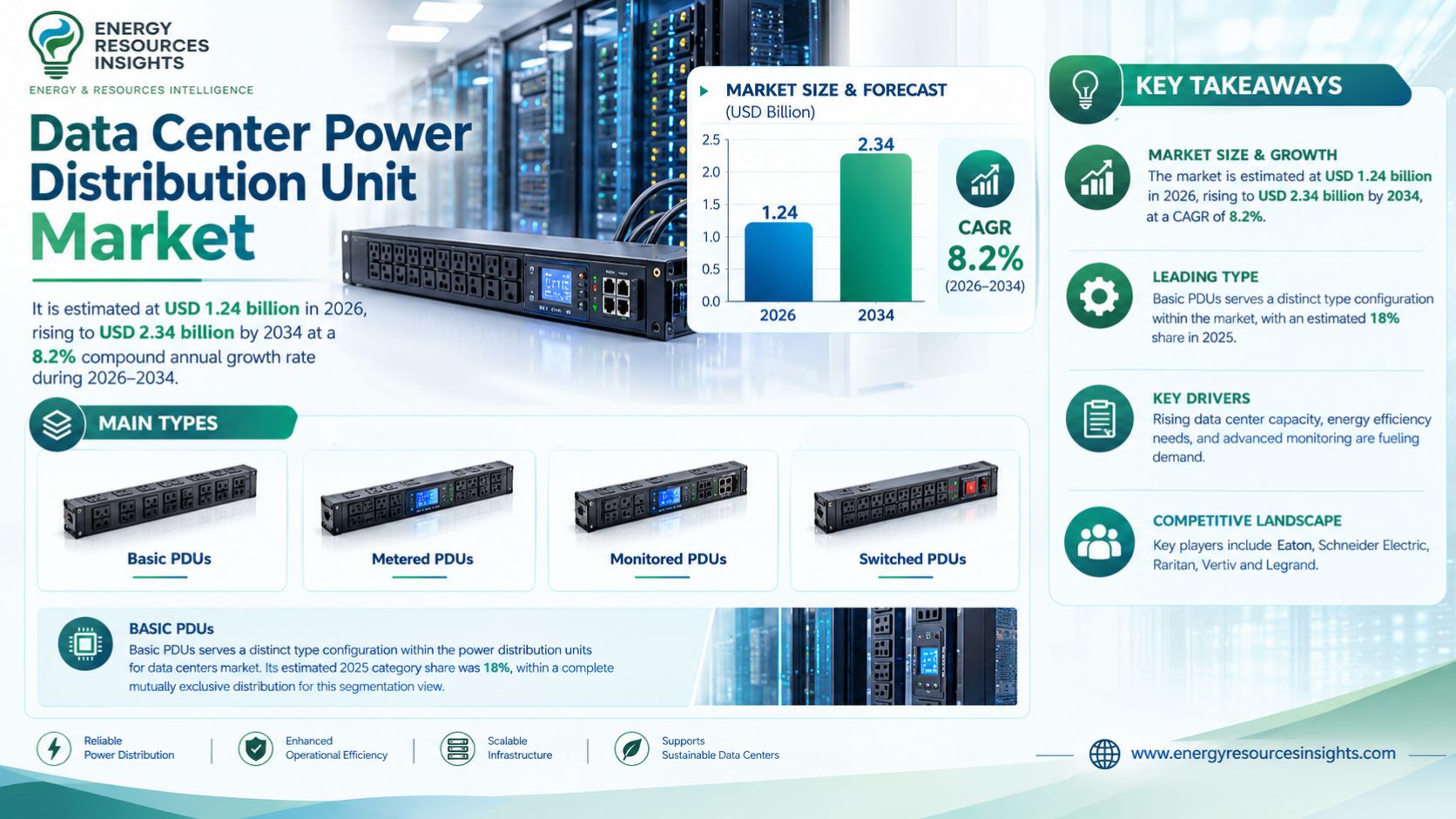
Data Center Power Distribution Unit Market Report
Data Center Power Distribution Unit Market to grow from USD 1.15 billion in 2025 to USD 2.34 billion by 2034, at an 8.2% CAGR, driven by AI infrastructure.
Rising AI workloads and high-density computing are accelerating demand for smarter, more efficient data center power distribution solutions.”
PUNE, MAHARASHTRA, INDIA, October 28, 2026 /EINPresswire.com/ -- Data Center Power Distribution Unit Market was valued at USD 1.15 billion in 2025. The market is projected to grow at a CAGR of 8.2% and is estimated to grow at USD 1.24 billion in 2026, rising to USD 2.34 billion by 2034 during 2026-2034. — EnergyResourcesInsights
Data Center Power Distribution Unit Market is entering a new phase as AI computing pushes data centres to manage higher electrical loads, tighter power-density requirements and uninterrupted operations.
► The International Energy Agency reported that global data centre electricity consumption reached approximately 415 TWh in 2024 and is projected to more than double to 945 TWh by 2030.
► In India, installed data centre capacity increased from around 375 MW in 2020 to 1,500 MW in 2025, according to the Ministry of Electronics and Information Technology.
𝐈𝐧𝐝𝐢𝐚'𝐬 𝐃𝐚𝐭𝐚 𝐂𝐞𝐧𝐭𝐞𝐫 𝐄𝐱𝐩𝐚𝐧𝐬𝐢𝐨𝐧 𝐂𝐫𝐞𝐚𝐭𝐞𝐬 𝐚 𝐍𝐞𝐰 𝐈𝐧𝐟𝐫𝐚𝐬𝐭𝐫𝐮𝐜𝐭𝐮𝐫𝐞 𝐎𝐩𝐩𝐨𝐫𝐭𝐮𝐧𝐢𝐭𝐲
India is becoming an important market to watch as cloud adoption, digital services, enterprise modernization and AI investments increase the need for reliable computing infrastructure.
According to India's Ministry of Electronics and Information Technology, the country's installed data center capacity increased from 375 MW in 2020 to approximately 1,575 MW in 2026. The government has also identified emerging investment destinations beyond established hubs, including Andhra Pradesh, Madhya Pradesh, Chhattisgarh and West Bengal.
This expansion creates opportunities for PDU suppliers across several deployment environments:
• Hyperscale facilities: Large-scale power distribution systems designed for extensive computing infrastructure.
• Colocation facilities: Intelligent PDUs that support customer-level power visibility and service accountability.
• Enterprise data centers: Flexible distribution systems for equipment refreshes, capacity expansion and modernization.
• Edge infrastructure: Compact power distribution products for smaller facilities and geographically distributed computing locations.
• AI infrastructure: Higher-capacity solutions designed around demanding computing workloads and evolving rack architectures.
For suppliers, the opportunity is not restricted to new construction. Existing facilities also require modernization as their computing requirements change, creating demand for replacement equipment, intelligent monitoring and adaptable power distribution.
💠𝗖𝗹𝗮𝗶𝗺 𝘆𝗼𝘂𝗿 𝗳𝗿𝗲𝗲 𝘀𝗮𝗺𝗽𝗹𝗲 𝗿𝗲𝗽𝗼𝗿𝘁 𝗳𝗼𝗿 𝗮𝗻 𝗼𝘃𝗲𝗿𝘃𝗶𝗲𝘄 𝗼𝗳 𝘁𝗵𝗲 𝗹𝗮𝘁𝗲𝘀𝘁 𝗺𝗮𝗿𝗸𝗲𝘁 𝗱𝗲𝘃𝗲𝗹𝗼𝗽𝗺𝗲𝗻𝘁𝘀: https://www.energyresourcesinsights.com/download-free-sample/1061/data-center-power-distribution-unit-market
𝐒𝐞𝐠𝐦𝐞𝐧𝐭𝐚𝐭𝐢𝐨𝐧 𝐀𝐧𝐚𝐥𝐲𝐬𝐢𝐬 𝐑𝐞𝐯𝐞𝐚𝐥𝐬 𝐖𝐡𝐞𝐫𝐞 𝐃𝐚𝐭𝐚 𝐂𝐞𝐧𝐭𝐞𝐫 𝐏𝐨𝐰𝐞𝐫 𝐃𝐢𝐬𝐭𝐫𝐢𝐛𝐮𝐭𝐢𝐨𝐧 𝐔𝐧𝐢𝐭 𝐃𝐞𝐦𝐚𝐧𝐝 𝐈𝐬 𝐂𝐨𝐧𝐜𝐞𝐧𝐭𝐫𝐚𝐭𝐞𝐝
𝐁𝐲 𝐓𝐲𝐩𝐞
• Monitored PDUs (accounting for an estimated 34% of 2025 market revenue, supporting real-time power monitoring and load visibility)
• Basic PDUs
• Metered PDUs
• Switched PDUs
𝐁𝐲 𝐀𝐩𝐩𝐥𝐢𝐜𝐚𝐭𝐢𝐨𝐧
• Hyperscale Data Centers (leading segment, representing an estimated 39% of 2025 market revenue, supported by large-scale cloud infrastructure and AI computing deployments)
• Colocation Data Centers
• Enterprise Data Centers
• AI & HPC Server Racks
𝐁𝐲 𝐈𝐧𝐬𝐭𝐚𝐥𝐥𝐚𝐭𝐢𝐨𝐧
• Rack-Mounted PDUs
• Floor-Standing PDUs
• Busway-Integrated PDUs
• Custom In-Cabinet PDUs
𝐁𝐲 𝐏𝐨𝐰𝐞𝐫 𝐂𝐨𝐧𝐟𝐢𝐠𝐮𝐫𝐚𝐭𝐢𝐨𝐧
• Single-Phase AC
• Three-Phase AC
• High-Density Multi-Feed
• DC Distribution
𝐓𝐡𝐞 𝟖𝟎𝟎 𝐕𝐃𝐂 𝐒𝐡𝐢𝐟𝐭: 𝐈𝐬 𝐭𝐡𝐞 𝐓𝐫𝐚𝐝𝐢𝐭𝐢𝐨𝐧𝐚𝐥 𝐑𝐚𝐜𝐤 𝐏𝐃𝐔 𝐀𝐩𝐩𝐫𝐨𝐚𝐜𝐡𝐢𝐧𝐠 𝐚 𝐃𝐞𝐬𝐢𝐠𝐧 𝐓𝐮𝐫𝐧𝐢𝐧𝐠 𝐏𝐨𝐢𝐧𝐭?
The next phase of data center power distribution is not simply about installing more rack PDUs. It is about rethinking how electricity moves from the utility connection to power-hungry AI accelerators. As rack power rises, conventional low-voltage AC architectures can require more conductors, conversion equipment and physical space.
A major industry signal emerged on September 22, 2026, when ABB introduced its Infinitus direct-current portfolio for AI data centers. ABB cited future AI chips drawing 1 MW or more per rack, compared with almost 200 kW today, as a reason to reconsider power distribution architectures. The company also estimates that approximately 25–40% of new data center capacity installed in 2030 could use DC distribution. These are ABB's projections, rather than independently verified market-wide outcomes.
The implications for the PDU market are significant: equipment suppliers may need to address evolving voltage architectures, power protection, monitoring and integration with facility-level systems not just socket counts and amperage ratings.
Why this section is distinctive? It connects the conventional rack PDU market to the emerging high-voltage DC ecosystem, while explaining that the transition will be gradual and architecture-dependent.
➣𝐁𝐚𝐬𝐢𝐜 𝐏𝐃𝐔𝐬: 𝐑𝐞𝐥𝐢𝐚𝐛𝐥𝐞 𝐃𝐢𝐬𝐭𝐫𝐢𝐛𝐮𝐭𝐢𝐨𝐧 𝐰𝐢𝐭𝐡𝐨𝐮𝐭 𝐀𝐝𝐯𝐚𝐧𝐜𝐞𝐝 𝐌𝐚𝐧𝐚𝐠𝐞𝐦𝐞𝐧𝐭
- Basic PDUs provide electrical distribution to equipment inside a rack. They remain relevant in applications where centralized monitoring is sufficient, advanced outlet controls are unnecessary, or procurement budgets prioritize essential functionality.
- Their continued relevance demonstrates that intelligent functionality will not replace every conventional product. Instead, market demand is likely to reflect a combination of basic distribution requirements and increasingly sophisticated installations.
➣ 𝐌𝐞𝐭𝐞𝐫𝐞𝐝 𝐚𝐧𝐝 𝐌𝐨𝐧𝐢𝐭𝐨𝐫𝐞𝐝 𝐏𝐃𝐔𝐬: 𝐕𝐢𝐬𝐢𝐛𝐢𝐥𝐢𝐭𝐲 𝐁𝐞𝐜𝐨𝐦𝐞𝐬 𝐭𝐡𝐞 𝐏𝐫𝐢𝐨𝐫𝐢𝐭𝐲
- Metered products provide electrical measurements, while monitored models can communicate power information remotely, depending on their configuration.
- These capabilities help operators understand rack consumption, manage electrical headroom and identify unusual conditions. They are particularly relevant to facilities where capacity planning and operational visibility are important.
➣ 𝐒𝐰𝐢𝐭𝐜𝐡𝐞𝐝 𝐏𝐃𝐔𝐬: 𝐏𝐨𝐰𝐞𝐫 𝐂𝐨𝐧𝐭𝐫𝐨𝐥 𝐚𝐭 𝐭𝐡𝐞 𝐎𝐮𝐭𝐥𝐞𝐭
- Switched PDUs add remote outlet control to power distribution and monitoring capabilities. Depending on the product, operators can remotely cycle power to connected equipment or sequence outlet activation.
- For distributed IT environments, these functions can reduce the need for physical intervention during certain maintenance and recovery activities.
𝐑𝐞𝐠𝐢𝐨𝐧𝐚𝐥 𝐏𝐞𝐫𝐟𝐨𝐫𝐦𝐚𝐧𝐜𝐞
𝐍𝐨𝐫𝐭𝐡 𝐀𝐦𝐞𝐫𝐢𝐜𝐚
North America remains a key market for data center power distribution units (PDUs), supported by hyperscale cloud facilities, colocation providers and growing investment in AI infrastructure. The expansion of high-density computing is increasing demand for intelligent rack PDUs that provide real-time power monitoring, remote switching and improved energy visibility.
The region’s established data center ecosystem also creates opportunities for manufacturers offering scalable power distribution, redundancy and integration with data center infrastructure management (DCIM) systems. As AI workloads increase rack-level power requirements, operators are placing greater emphasis on power reliability, capacity planning and efficient electricity utilization.
𝐀𝐬𝐢𝐚 𝐏𝐚𝐜𝐢𝐟𝐢𝐜
Asia Pacific is emerging as a major growth region, supported by cloud adoption, digital transformation and data center expansion across China, India, Japan, Singapore and other Southeast Asian markets. Rising demand for AI services, online platforms and enterprise computing is encouraging operators to invest in more advanced power distribution systems.
𝐄𝐮𝐫𝐨𝐩𝐞
Europe remains an important market for data center power distribution units, driven by cloud infrastructure investment, colocation expansion and growing emphasis on energy efficiency. Established data center hubs such as Frankfurt, London, Amsterdam and Paris continue to support demand for dependable power distribution, monitoring and control solutions.
However, limited grid capacity and delays in securing power connections are influencing where new facilities are developed. These constraints are strengthening the value of intelligent PDUs that help operators monitor electricity consumption, manage rack-level loads and improve visibility across increasingly complex facilities. Sustainability reporting and energy-efficiency objectives are also encouraging operators to evaluate power distribution equipment beyond its initial purchase cost.
𝐋𝐚𝐭𝐢𝐧 𝐀𝐦𝐞𝐫𝐢𝐜𝐚
Latin America is gaining traction as data center operators explore new locations to serve cloud, digital services and enterprise computing demand. Brazil, Mexico and Chile are among the important markets, with São Paulo and Santiago attracting activity from colocation and hyperscale providers.
In the first quarter of 2025, São Paulo recorded 71.2 MW of data center net absorption, while Santiago recorded 24.1 MW, reflecting demand for additional capacity in these markets. This expansion creates opportunities for PDU suppliers offering reliable power distribution, remote monitoring and adaptable configurations. Nevertheless, regional differences in electricity availability, infrastructure readiness and project execution can influence procurement timelines and equipment selection.
𝐌𝐢𝐝𝐝𝐥𝐞 𝐄𝐚𝐬𝐭 𝐚𝐧𝐝 𝐀𝐟𝐫𝐢𝐜𝐚
The Middle East and Africa region is developing as an emerging opportunity for data center PDU manufacturers, supported by digital transformation programmes, cloud adoption and investment in AI-ready infrastructure. Saudi Arabia and the United Arab Emirates are attracting attention through their ambitions to expand digital infrastructure, while South Africa remains an important data center market on the African continent.
💠𝐄𝐱𝐩𝐥𝐨𝐫𝐞 𝐭𝐡𝐞 𝐃𝐚𝐭𝐚 𝐂𝐞𝐧𝐭𝐞𝐫 𝐏𝐨𝐰𝐞𝐫 𝐃𝐢𝐬𝐭𝐫𝐢𝐛𝐮𝐭𝐢𝐨𝐧 𝐔𝐧𝐢𝐭 𝐌𝐚𝐫𝐤𝐞𝐭 𝐫𝐞𝐬𝐞𝐚𝐫𝐜𝐡: https://www.energyresourcesinsights.com/data-center-power-distribution-unit-market-1061
𝐓𝐡𝐞 𝐁𝐮𝐬𝐢𝐧𝐞𝐬𝐬 𝐂𝐚𝐬𝐞 𝐈𝐬 𝐒𝐡𝐢𝐟𝐭𝐢𝐧𝐠 𝐅𝐫𝐨𝐦 𝐏𝐮𝐫𝐜𝐡𝐚𝐬𝐞 𝐏𝐫𝐢𝐜𝐞 𝐭𝐨 𝐋𝐢𝐟𝐞𝐭𝐢𝐦𝐞 𝐎𝐩𝐞𝐫𝐚𝐭𝐢𝐧𝐠 𝐕𝐚𝐥𝐮𝐞
A PDU purchase can appear relatively straightforward when assessed through its initial equipment cost. However, data center operators must consider the wider consequences of power distribution decisions.
A product that provides better monitoring, simplifies maintenance or supports future rack changes may deliver operational value beyond its purchase price. Conversely, excessive specifications can add unnecessary costs when the application does not require advanced capabilities.
𝗔 𝗺𝗼𝗿𝗲 𝘂𝘀𝗲𝗳𝘂𝗹 𝗽𝗿𝗼𝗰𝘂𝗿𝗲𝗺𝗲𝗻𝘁 𝗳𝗿𝗮𝗺𝗲𝘄𝗼𝗿𝗸 𝗰𝗼𝗻𝘀𝗶𝗱𝗲𝗿𝘀 𝗳𝗼𝘂𝗿 𝗱𝗶𝗺𝗲𝗻𝘀𝗶𝗼𝗻𝘀:
𝟭. 𝗖𝗼𝘀𝘁 𝗼𝗳 𝗗𝗲𝗽𝗹𝗼𝘆𝗺𝗲𝗻𝘁: Installation time, electrical compatibility, rack-space requirements and commissioning effort.
𝟮. 𝗖𝗼𝘀𝘁 𝗼𝗳 𝗢𝗽𝗲𝗿𝗮𝘁𝗶𝗼𝗻: Maintenance requirements, monitoring capabilities, operational efficiency and the effort required to manage distributed equipment.
𝟯. 𝗖𝗼𝘀𝘁 𝗼𝗳 𝗙𝗮𝗶𝗹𝘂𝗿𝗲: Potential service disruption, equipment exposure and the consequences of power distribution problems.
𝟰. 𝗖𝗼𝘀𝘁 𝗼𝗳 𝗘𝘅𝗽𝗮𝗻𝘀𝗶𝗼𝗻: The additional investment needed when rack densities, outlet requirements or computing workloads change.
This approach creates an opportunity for manufacturers to differentiate their products through measurable operating benefits rather than relying exclusively on hardware specifications.
𝐖𝐡𝐚𝐭 𝐂𝐨𝐮𝐥𝐝 𝐒𝐥𝐨𝐰 𝐀𝐝𝐨𝐩𝐭𝐢𝐨𝐧?
Despite the market's favorable structural drivers, purchasing decisions remain subject to practical constraints.
►𝗛𝗶𝗴𝗵 𝗶𝗻𝗶𝘁𝗶𝗮𝗹 𝗶𝗻𝘃𝗲𝘀𝘁𝗺𝗲𝗻𝘁: Advanced monitoring, outlet-level controls and higher-capacity configurations can increase upfront costs. Some smaller facilities may continue to prefer basic products.
►𝗘𝗹𝗲𝗰𝘁𝗿𝗶𝗰𝗮𝗹 𝗰𝗼𝗺𝗽𝗮𝘁𝗶𝗯𝗶𝗹𝗶𝘁𝘆: Different voltage requirements, connector standards, phases and upstream power architectures can complicate standardization across international installations.
►𝗟𝗲𝗴𝗮𝗰𝘆 𝗶𝗻𝗳𝗿𝗮𝘀𝘁𝗿𝘂𝗰𝘁𝘂𝗿𝗲: Existing data centers may face space, cabling or electrical constraints that limit the adoption of newer high-density configurations.
►𝗖𝘆𝗯𝗲𝗿𝘀𝗲𝗰𝘂𝗿𝗶𝘁𝘆 𝗰𝗼𝗻𝘀𝗶𝗱𝗲𝗿𝗮𝘁𝗶𝗼𝗻𝘀: Network-connected PDUs introduce management interfaces that require appropriate access controls, firmware maintenance and integration with organizational security policies.
►𝗣𝗼𝘄𝗲𝗿 𝗮𝘃𝗮𝗶𝗹𝗮𝗯𝗶𝗹𝗶𝘁𝘆: A sophisticated PDU cannot overcome insufficient upstream electrical capacity. Grid connections, switchgear, transformers, backup systems and cooling infrastructure must support the intended computing load.
These considerations reinforce the importance of evaluating the complete power chain rather than treating the PDU as an independent purchase.
𝐓𝐡𝐞 𝐂𝐨𝐦𝐩𝐞𝐭𝐢𝐭𝐢𝐯𝐞 𝐋𝐚𝐧𝐝𝐬𝐜𝐚𝐩𝐞: 𝐇𝐚𝐫𝐝𝐰𝐚𝐫𝐞 𝐄𝐱𝐩𝐞𝐫𝐭𝐢𝐬𝐞 𝐌𝐮𝐬𝐭 𝐌𝐞𝐞𝐭 𝐃𝐢𝐠𝐢𝐭𝐚𝐥 𝐈𝐧𝐭𝐞𝐠𝐫𝐚𝐭𝐢𝐨𝐧
Competition in the Data Center Power Distribution Unit Market spans electrical equipment manufacturers, critical-infrastructure providers and specialized rack-power suppliers.
Established participants include:
• 𝐒𝐜𝐡𝐧𝐞𝐢𝐝𝐞𝐫 𝐄𝐥𝐞𝐜𝐭𝐫𝐢𝐜: Rack power distribution through its APC NetShelter portfolio, alongside broader data center power and management solutions.
• 𝐕𝐞𝐫𝐭𝐢𝐯: Rack-level power distribution, monitoring and switched-power products within its critical digital infrastructure portfolio.
• 𝐄𝐚𝐭𝐨𝐧: Electrical power management and data center infrastructure solutions.
The competitive landscape should be assessed through product capabilities, rather than brand recognition alone. Relevant comparison points include electrical capacity, monitoring granularity, outlet configurations, remote management, interoperability, security features, availability and service support.
As infrastructure becomes more integrated, suppliers that can work effectively with rack manufacturers, server vendors, and electrical contractors and data center operators may be better positioned to support complex deployments.
𝐋𝐞𝐚𝐝𝐢𝐧𝐠 𝐂𝐨𝐦𝐩𝐚𝐧𝐢𝐞𝐬 𝐏𝐫𝐨𝐟𝐢𝐥𝐞𝐝:
🔸Legrand
🔸Schneider Electric
🔸Vertiv
🔸Eaton
🔸Raritan
🔸Server Technology
🔸CyberPower
🔸nVent
🔸ABB
🔸Tripp Lite
🔸Others
𝐓𝐡𝐞 𝐍𝐞𝐰 𝐏𝐫𝐨𝐝𝐮𝐜𝐭 𝐁𝐚𝐭𝐭𝐥𝐞: 𝐌𝐨𝐫𝐞 𝐕𝐢𝐬𝐢𝐛𝐢𝐥𝐢𝐭𝐲 𝐰𝐢𝐭𝐡𝐨𝐮𝐭 𝐌𝐨𝐫𝐞 𝐎𝐩𝐞𝐫𝐚𝐭𝐢𝐨𝐧𝐚𝐥 𝐂𝐨𝐦𝐩𝐥𝐞𝐱𝐢𝐭𝐲
Intelligent PDUs are competing on more than remote switching. Buyers also need reliable metering, environmental visibility, simpler deployment and manageable network overhead across large numbers of racks.
2026 launches illustrate this direction:
• 𝗙𝗲𝗯𝗿𝘂𝗮𝗿𝘆 𝟮𝟲, 𝟮𝟬𝟮𝟲 : CPI announced eConnect Universal Input PDUs and an eConnect Sensor Array. The sensor array supports monitoring of temperature, humidity, leaks, cabinet-door status and access events, adding environmental context to rack-level power information.
• 𝗝𝘂𝗹𝘆 𝟮𝟬𝟮𝟲: Panduit announced its ES2P managed rack PDU, with gigabit Ethernet connectivity, metering accuracy of ±2%, support for daisy-chaining up to 16 PDUs per IP address, and operation at full load in ambient temperatures up to 55°C.
𝐓𝐨𝐩 𝟐 𝐒𝐢𝐠𝐧𝐚𝐥𝐬 𝐓𝐡𝐚𝐭 𝐂𝐨𝐮𝐥𝐝 𝐒𝐡𝐚𝐩𝐞 𝐭𝐡𝐞 𝐭𝐚𝐫𝐠𝐞𝐭 𝐌𝐚𝐫𝐤𝐞𝐭 𝐓𝐡𝐫𝐨𝐮𝐠𝐡 𝟐𝟎𝟑𝟒
𝟭. 𝗔𝗜 𝗥𝗮𝗰𝗸 𝗦𝘁𝗮𝗻𝗱𝗮𝗿𝗱𝗶𝘇𝗮𝘁𝗶𝗼𝗻
Greater standardization of rack architectures could influence outlet configurations, PDU form factors, electrical requirements and procurement specifications.
𝟮. 𝗣𝗼𝘄𝗲𝗿 𝗠𝗼𝗻𝗶𝘁𝗼𝗿𝗶𝗻𝗴 𝗮𝘀 𝗮 𝗗𝗲𝗳𝗮𝘂𝗹𝘁 𝗥𝗲𝗾𝘂𝗶𝗿𝗲𝗺𝗲𝗻𝘁
As rack densities rise, detailed power visibility may become increasingly important for capacity planning, customer reporting and operational oversight.
𝐖𝐡𝐞𝐫𝐞 𝐌𝐚𝐫𝐤𝐞𝐭 𝐈𝐧𝐭𝐞𝐥𝐥𝐢𝐠𝐞𝐧𝐜𝐞 𝐂𝐚𝐧 𝐈𝐦𝐩𝐫𝐨𝐯𝐞 𝐈𝐧𝐯𝐞𝐬𝐭𝐦𝐞𝐧𝐭 𝐃𝐞𝐜𝐢𝐬𝐢𝐨𝐧𝐬
Data Center Power Distribution Unit Market requires a more detailed assessment than a simple forecast of equipment demand. The number of facilities being built is only one part of the opportunity; their rack configurations, computing workloads, electrical architectures and purchasing requirements also matter.
For manufacturers, this information can help identify product-development priorities and potential customer segments. For investors, it can support a clearer understanding of the relationship between AI infrastructure spending and demand for supporting electrical equipment. For procurement teams, it can help compare product capabilities with actual operating requirements.
A useful market assessment should distinguish between demand for conventional rack distribution, intelligent monitoring products, switched configurations and higher-capacity solutions. It should also evaluate how purchasing priorities vary between hyperscale operators, colocation providers, enterprise facilities and edge deployments.
𝐆𝐞𝐭 𝐚 𝐩𝐫𝐞𝐯𝐢𝐞𝐰 𝐰𝐢𝐭𝐡 𝐅𝐫𝐞𝐞 𝐑𝐞𝐩𝐨𝐫𝐭 𝐜𝐨𝐩𝐲: https://www.energyresourcesinsights.com/download-free-sample/1061/data-center-power-distribution-unit-market
𝐅𝐫𝐨𝐦 𝐄𝐪𝐮𝐢𝐩𝐦𝐞𝐧𝐭 𝐒𝐩𝐞𝐜𝐢𝐟𝐢𝐜𝐚𝐭𝐢𝐨𝐧 𝐭𝐨 𝐈𝐧𝐟𝐫𝐚𝐬𝐭𝐫𝐮𝐜𝐭𝐮𝐫𝐞 𝐈𝐧𝐭𝐞𝐠𝐫𝐚𝐭𝐢𝐨𝐧: 𝐖𝐡𝐚𝐭 𝐁𝐮𝐲𝐞𝐫𝐬 𝐌𝐚𝐲 𝐄𝐯𝐚𝐥𝐮𝐚𝐭𝐞 𝐍𝐞𝐱𝐭
Traditional PDU selection often begins with voltage, current rating, outlet configuration, mounting format and redundancy requirements. For newer AI-oriented deployments, buyers may also examine how the unit fits into a wider power architecture.
𝐅𝐢𝐧𝐚𝐥 𝐄𝐯𝐚𝐥𝐮𝐚𝐭𝐢𝐨𝐧 𝐀𝐫𝐞𝐚𝐬
- 𝐑𝐚𝐜𝐤-𝐋𝐞𝐯𝐞𝐥 𝐏𝐨𝐰𝐞𝐫 𝐕𝐢𝐬𝐢𝐛𝐢𝐥𝐢𝐭𝐲: Provides clear insights into power load distribution and available capacity across racks.
- 𝐌𝐨𝐧𝐢𝐭𝐨𝐫𝐢𝐧𝐠 𝐚𝐧𝐝 𝐓𝐞𝐥𝐞𝐦𝐞𝐭𝐫𝐲: Enables remote monitoring and helps identify abnormal operating conditions more quickly.
- 𝐇𝐢𝐠𝐡-𝐃𝐞𝐧𝐬𝐢𝐭𝐲 𝐂𝐨𝐦𝐩𝐚𝐭𝐢𝐛𝐢𝐥𝐢𝐭𝐲: Ensures rack power distribution can support evolving server configurations and increasing accelerator power demands.
- 𝐈𝐧𝐭𝐞𝐠𝐫𝐚𝐭𝐢𝐨𝐧 𝐑𝐞𝐚𝐝𝐢𝐧𝐞𝐬𝐬: Facilitates integration with Data Center Infrastructure Management (DCIM) platforms, sensors, and broader facility management systems.
- 𝐀𝐫𝐜𝐡𝐢𝐭𝐞𝐜𝐭𝐮𝐫𝐞 𝐅𝐥𝐞𝐱𝐢𝐛𝐢𝐥𝐢𝐭𝐲: Supports future infrastructure planning as operators explore hybrid AC/DC systems and next-generation high-voltage power distribution designs.
These considerations should not be presented as universal requirements for every facility. A small enterprise server room, a colocation operator and a hyperscale AI campus can have very different power profiles and purchasing criteria. The strongest suppliers will be those that match product capabilities to the customer's actual operating environment.
𝐅𝐢𝐧𝐝 𝐭𝐡𝐞 𝐑𝐞𝐥𝐚𝐭𝐞𝐝 𝐑𝐞𝐩𝐨𝐫𝐭 𝐡𝐞𝐫𝐞:
🔸𝐈𝐧𝐭𝐞𝐥𝐥𝐢𝐠𝐞𝐧𝐭 𝐑𝐚𝐜𝐤 𝐏𝐨𝐰𝐞𝐫 𝐃𝐢𝐬𝐭𝐫𝐢𝐛𝐮𝐭𝐢𝐨𝐧 𝐔𝐧𝐢𝐭 𝐌𝐚𝐫𝐤𝐞𝐭: https://www.intelmarketresearch.com/intelligent-rack-power-distribution-unit-market-59334
🔸𝐌𝐞𝐭𝐞𝐫𝐢𝐧𝐠 𝐏𝐨𝐰𝐞𝐫 𝐃𝐢𝐬𝐭𝐫𝐢𝐛𝐮𝐭𝐢𝐨𝐧 𝐔𝐧𝐢𝐭𝐬 (𝐌𝐞𝐭𝐞𝐫𝐞𝐝 𝐏𝐃𝐔) 𝐌𝐚𝐫𝐤𝐞𝐭: https://www.intelmarketresearch.com/metering-power-distribution-units-market-8900
🔸𝐀𝐈-𝐒𝐩𝐞𝐜𝐢𝐟𝐢𝐜 𝐏𝐨𝐰𝐞𝐫 𝐃𝐢𝐬𝐭𝐫𝐢𝐛𝐮𝐭𝐢𝐨𝐧 𝐔𝐧𝐢𝐭 𝐌𝐚𝐫𝐤𝐞𝐭: https://semiconductorinsight.com/report/ai-specific-power-distribution-unit-market/
🔸𝐁𝐢𝐦𝐞𝐭𝐚𝐥 𝐓𝐞𝐦𝐩𝐞𝐫𝐚𝐭𝐮𝐫𝐞 𝐒𝐰𝐢𝐭𝐜𝐡𝐞𝐬 𝐌𝐚𝐫𝐤𝐞𝐭: https://www.24chemicalresearch.com/reports/304809/bimetal-temperature-switches-market
𝐀𝐛𝐨𝐮𝐭 𝐄𝐧𝐞𝐫𝐠𝐲𝐑𝐞𝐬𝐨𝐮𝐫𝐜𝐞𝐬𝐈𝐧𝐬𝐢𝐠𝐡𝐭𝐬
EnergyResourcesInsights is a specialized market research and advisory platform focused on the industries that produce, move, store and transform energy and natural resources. Its work helps decision-makers understand market size, demand, technology shifts, competitive dynamics, investment priorities and the forces reshaping energy and resource value chains. The company examines connected markets across generation, infrastructure, fuels, technologies, equipment, storage, minerals and industrial demand to support growth, investment, product strategy, market entry, sourcing and long-term planning.
𝐂𝐨𝐧𝐭𝐚𝐜𝐭 𝐔𝐬:
▪️𝐏𝐡𝐨𝐧𝐞: +91 94251 50513
▪️𝐄𝐦𝐚𝐢𝐥: help@energyresourcesinsights.com
▪️𝐖𝐞𝐛𝐬𝐢𝐭𝐞: www.energyresourcesinsights.com
Pranjal Chougule
24webtech Business solutions LLP
+91 80879 92013
Legal Disclaimer:
EIN Presswire provides this news content "as is" without warranty of any kind. We do not accept any responsibility or liability for the accuracy, content, images, videos, licenses, completeness, legality, or reliability of the information contained in this article. If you have any complaints or copyright issues related to this article, kindly contact the author above.
