

Biomass Power Generation Market to Reach USD 137.39 Billion by 2032 on Strong Waste-to-Energy Adoption
Rising focus on circular economy, industrial decarbonization, & energy security drives steady growth in the global biomass power generation market through 2032.
Biomass power is uniquely positioned to deliver dispatchable renewable energy while advancing circular economy and decarbonization goals.”
PUNE, MAHARASHTRA, INDIA, February 5, 2026 /EINPresswire.com/ -- Biomass Power Generation Market Outlook Strengthens Amid Global Energy Transition— Fortune Business Insights
The global biomass power generation market 2026 is gaining steady momentum as governments, utilities, and industries seek dispatchable renewable energy solutions that complement solar and wind. Biomass power generation plays a critical role in energy security, waste management, and decarbonization by converting organic waste and residues into reliable electricity and heat.
According to Fortune Business Insights, the global biomass power generation market was valued at USD 98.28 billion in 2024, reached USD 101.96 billion in 2025, and is projected to grow to USD 137.39 billion by 2032, exhibiting a CAGR of 4.35% during 2025–2032. Asia Pacific dominated the market with a 39.01% share in 2024, supported by rapid industrialization, urbanization, and abundant biomass resources.
Get Sample Report PDF:
https://www.fortunebusinessinsights.com/enquiry/request-sample-pdf/100746
Market Snapshot: Biomass Power Generation Market 2026
• Market Value (2024): USD 98.28 Billion
• Estimated Market Size (2026): Continued expansion backed by WtE and CHP projects
• Forecast Market Value (2032): USD 137.39 Billion
• CAGR (2025–2032): 4.35%
• Leading Feedstock: Municipal Solid Waste (MSW)
• Dominant Technology: Combustion
• Key Application: Industrial
• Largest Region: Asia Pacific
Market Overview: Biomass as a Dispatchable Renewable Energy Source
Biomass power generation involves producing electricity from organic materials such as agricultural residues, forest waste, animal waste, and municipal solid waste. Unlike intermittent renewables, biomass offers stable, dispatchable power and can operate continuously, making it valuable for grid stability and baseload generation.
In the global biomass power generation market 2026, biomass is increasingly positioned as a dual-purpose solution—addressing both renewable energy generation and sustainable waste management. Its role in supporting circular economy models and reducing landfill dependence strengthens its long-term relevance within national energy strategies.
Key Market Drivers Supporting Growth
Waste-to-Energy and Circular Economy Initiatives
The growing emphasis on waste-to-energy (WtE) solutions is a major driver for biomass power generation market growth. Urbanization and rising waste volumes are pushing municipalities to adopt technologies that convert municipal solid waste into electricity and heat. WtE facilities help reduce landfill usage, lower methane emissions, and recover energy from waste streams.
Governments across Europe, Asia Pacific, and the Middle East are promoting waste valorization through policy support, renewable energy targets, and infrastructure investments. These initiatives position biomass-based WtE systems as a core component of sustainable urban development.
Abundant Availability of Agricultural and Forestry Residues
The widespread availability of agricultural and forestry residues continues to fuel market expansion. Crop residues such as bagasse, rice husks, and straw, along with forestry by-products, provide a low-cost and locally available feedstock base. In agricultural economies across Asia Pacific and Latin America, biomass power supports rural income generation while mitigating open-field burning and related emissions.
Market Restraints Limiting Expansion
Competition from Low-Cost Renewables
The declining cost of solar PV, wind energy, and battery storage presents a notable restraint for the biomass power generation market. These technologies offer lower levelized costs of electricity and simpler project economics. In comparison, biomass projects face higher capital expenditure and ongoing feedstock logistics costs.
As renewable portfolios increasingly prioritize cost efficiency, biomass power projects often rely on policy incentives, renewable energy certificates, and carbon pricing mechanisms to remain competitive.
Emerging Market Opportunities
Industrial Decarbonization through Biomass CHP
Biomass-based combined heat and power (CHP) systems represent a major growth opportunity. CHP plants simultaneously generate electricity and usable heat, achieving efficiencies above 80%. Industries such as pulp and paper, food processing, chemicals, and cement are increasingly adopting biomass CHP to decarbonize operations and reduce exposure to volatile fossil fuel prices.
Supportive climate policies, carbon pricing frameworks, and corporate net-zero commitments are accelerating the adoption of biomass CHP across industrial sectors in the global biomass power generation market 2026.
Biomass Power Generation Market Trends
Rising Government Climate and Emissions Pressure
A defining trend in the market is the growing regulatory and climate pressure from governments worldwide. Countries are strengthening renewable portfolio standards, carbon reduction mandates, and bioenergy incentives to meet net-zero targets. Biomass power is increasingly recognized for its ability to deliver low-carbon, dispatchable energy while utilizing waste and residues.
This regulatory momentum is encouraging long-term investment in biomass electricity and CHP projects, particularly in regions pursuing aggressive decarbonization pathways.
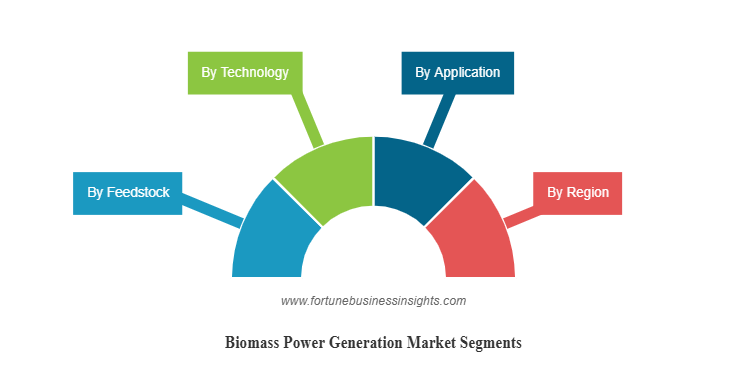
Segmentation Insights
By Feedstock
• Municipal Solid Waste (MSW) leads due to rising urban waste volumes and WtE policies
• Agricultural residues are the fastest-growing segment, supported by rural energy initiatives
By Technology
• Combustion dominates with over 60% market share, driven by proven scalability and efficiency
• Gasification is gaining traction due to higher efficiency and cleaner emissions
By Application
• Industrial applications dominate, driven by biomass cogeneration for manufacturing
• Commercial segment is growing rapidly with adoption in urban heating and power systems
Regional Outlook
Asia Pacific
Asia Pacific leads the biomass power generation market, supported by industrial growth, waste generation, and abundant feedstock availability. China, India, and Japan are investing heavily in biomass and WtE projects to enhance energy security and sustainability.
Europe
Europe remains a key market, driven by stringent climate regulations, renewable energy targets, and strong policy support under frameworks such as RED II.
North America
North America benefits from decentralized renewable energy initiatives, landfill diversion goals, and supportive tax incentives, particularly in the U.S.
Latin America and Middle East & Africa
These regions are experiencing steady growth due to agricultural residues, rural electrification needs, and emerging waste-to-energy projects.
Competitive Landscape
The biomass power generation market is fragmented, with players focusing on strategic partnerships, technology upgrades, and regional expansion.
Key Companies Include
• ENGIE
• Drax Group
• Ørsted A/S
• Siemens
• General Electric
• Vattenfall
• Veolia
Collaborations, waste-to-energy investments, and industrial CHP deployments remain central to competitive strategies.
Get Sample Report PDF:
https://www.fortunebusinessinsights.com/enquiry/request-sample-pdf/100746
Conclusion
As nations pursue energy security, emissions reduction, and sustainable waste management, the global biomass power generation market 2026 is set to remain a vital pillar of the renewable energy mix. With strong policy backing, expanding industrial CHP adoption, and growing waste-to-energy initiatives, biomass power generation is positioned for steady long-term growth through 2032.
Ashwin Arora
Fortune Business Insights™ Pvt. Ltd.
+1 83390 92966
sales@fortunebusinessinsights.com
Legal Disclaimer:
EIN Presswire provides this news content "as is" without warranty of any kind. We do not accept any responsibility or liability for the accuracy, content, images, videos, licenses, completeness, legality, or reliability of the information contained in this article. If you have any complaints or copyright issues related to this article, kindly contact the author above.
